
'%3e%3cpath%20d='M7.31055%200C11.3483%200%2014.6227%203.27289%2014.623%207.31055C14.623%209.0259%2014.0303%2010.6024%2013.041%2011.8496L15.7549%2014.5625C16.0837%2014.8913%2016.0837%2015.4241%2015.7549%2015.7529C15.4261%2016.0817%2014.8933%2016.0817%2014.5645%2015.7529L11.8516%2013.0391C10.604%2014.0293%209.02689%2014.623%207.31055%2014.623C3.27289%2014.6227%200%2011.3483%200%207.31055C0.000300342%203.27308%203.27308%200.000300342%207.31055%200ZM7.31055%201.68359C4.20324%201.68389%201.68389%204.20324%201.68359%207.31055C1.68359%2010.4181%204.20305%2012.9372%207.31055%2012.9375C10.4183%2012.9375%2012.9375%2010.4183%2012.9375%207.31055C12.9372%204.20305%2010.4181%201.68359%207.31055%201.68359Z'%20fill='%23D9D9D9'/%3e%3c/g%3e%3cdefs%3e%3cclipPath%20id='clip0_0_2110'%3e%3crect%20width='16'%20height='16'%20fill='white'/%3e%3c/clipPath%3e%3c/defs%3e%3c/svg%3e)

'%3e%3ccircle%20cx='8'%20cy='8'%20r='8'%20fill='%23313131'/%3e%3cpath%20d='M7.59985%203.19995C8.04162%203.19995%208.39955%203.55802%208.39966%203.99976V8.34253L10.7844%209.71948C11.167%209.94041%2011.2973%2010.4306%2011.0764%2010.8132C10.8554%2011.1954%2010.3661%2011.326%209.98364%2011.1052L7.21313%209.50562C7.14844%209.46826%207.09109%209.42271%207.04126%209.37183C7.03714%209.3678%207.03357%209.36324%207.02954%209.35913C7.00625%209.33429%206.98478%209.30827%206.96509%209.28101C6.86323%209.14677%206.80005%208.98107%206.80005%208.79956V3.99976C6.80015%203.55808%207.15818%203.20006%207.59985%203.19995Z'%20fill='white'%20fill-opacity='0.7'/%3e%3c/g%3e%3cdefs%3e%3cclipPath%20id='clip0_3_1208'%3e%3crect%20width='16'%20height='16'%20fill='white'/%3e%3c/clipPath%3e%3c/defs%3e%3c/svg%3e)
'%3e%3cmask%20id='mask0_108_4890'%20style='mask-type:luminance'%20maskUnits='userSpaceOnUse'%20x='0'%20y='0'%20width='108'%20height='108'%3e%3ccircle%20cx='54'%20cy='54'%20r='54'%20fill='white'/%3e%3c/mask%3e%3cg%20mask='url(%23mask0_108_4890)'%3e%3ccircle%20cx='54'%20cy='54'%20r='54'%20fill='%231A1A1A'/%3e%3cpath%20d='M54%2069C77.196%2069%2096%2087.804%2096%20111C96%20134.196%2077.196%20153%2054%20153C30.804%20153%2012%20134.196%2012%20111C12%2087.804%2030.804%2069%2054%2069ZM54%2018C65.598%2018%2075%2027.402%2075%2039C75%2050.598%2065.598%2060%2054%2060C42.402%2060%2033%2050.598%2033%2039C33%2027.402%2042.402%2018%2054%2018Z'%20fill='%23313131'/%3e%3ccircle%20cx='54'%20cy='54'%20r='53.25'%20stroke='%23323232'%20stroke-width='1.5'/%3e%3c/g%3e%3c/g%3e%3cdefs%3e%3cclipPath%20id='clip0_108_4890'%3e%3crect%20width='54'%20height='54'%20fill='white'%20transform='scale(2)'/%3e%3c/clipPath%3e%3c/defs%3e%3c/svg%3e)


Overview of The Grim Grimoire
The Grim Grimoire is a dark fantasy short drama built around one irresistible nightmare: what if the story you were trying to fix was quietly rewriting you instead? The series follows Alice, who inherits a sentient Grimoire capable of altering reality whenever she repairs its damaged words. At first, the book appears to be a magical inheritance, a strange but powerful object that might answer questions about fate, memory, and hidden worlds. But the deeper Alice reads, the more dangerous the bargain becomes. Every correction changes the fabric of her reality, and every repaired phrase brings her closer to the truth that the Grimoire does not serve her at all.
That discovery pulls Alice into the Margins, a void between stories where unfinished narratives, broken rules, and predatory magic seem to survive outside ordinary life. The central tension of The Grim Grimoire lies in Alice’s shifting role: she begins as a reluctant heir, becomes a hunted figure, and must eventually turn the logic of the book against itself. Armed with mystical shears, Alice fights not just monsters or illusions, but the idea that her ending has already been written. The Grim Grimoire blends cursed-object horror, metaphysical fantasy, and survival drama into a story about authorship, sacrifice, and the terrifying cost of changing fate.
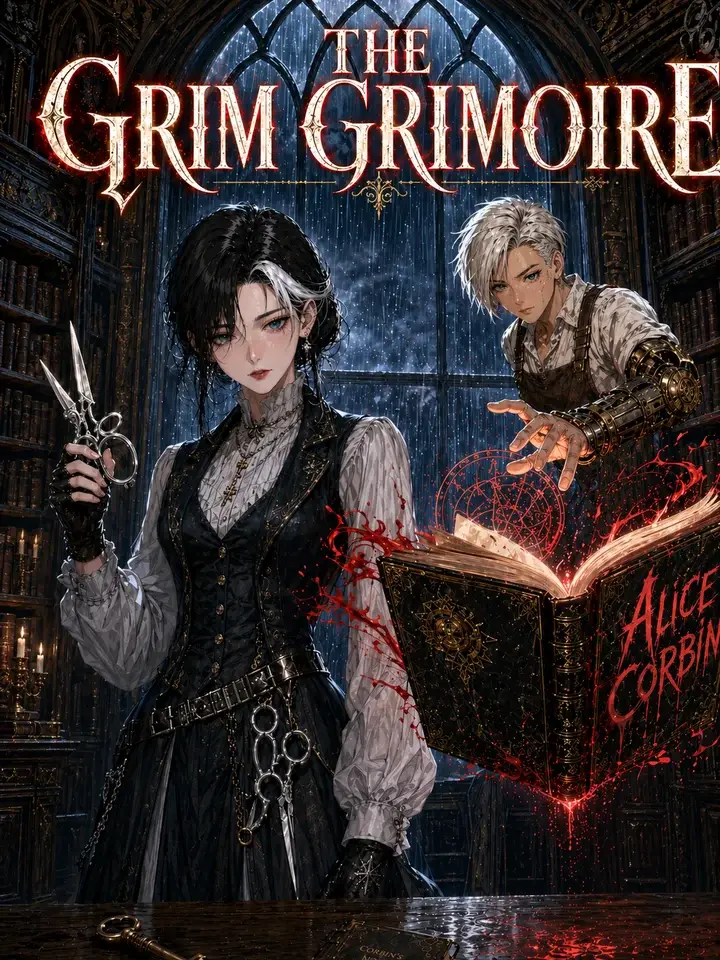
The Cursed Book and the Reality-Rewriting Premise of The Grim Grimoire
At the heart of The Grim Grimoire is a deceptively simple premise with enormous dramatic consequences. Alice inherits a book that is not merely old, enchanted, or dangerous, but alive in a narrative sense. The Grimoire responds to language. When Alice repairs its words, the world around her changes. This makes the book fascinating because its magic is not based on spells spoken aloud in the usual fantasy tradition; instead, it treats writing itself as reality’s operating system. A missing word, a damaged sentence, or a repaired passage can shift what is true.
That power first suggests possibility. Alice might believe she has found a way to restore what is broken, uncover hidden truths, or regain control over circumstances beyond her reach. Yet The Grim Grimoire quickly complicates that fantasy. The book’s sentience means it has desire, strategy, and hunger. It is not a neutral tool waiting for a chosen owner. It is an active force guiding Alice toward a predetermined role: the next sacrifice.
The Margins intensify this revelation. As a void between stories, the Margins are more than a setting; they are a visual and philosophical threat. They imply that stories have borders, and that something terrible lives in the spaces where those borders fail. Alice is dragged out of the stable world and into a place where narrative structure itself becomes hostile. The rules she relies on no longer hold, because the Grimoire can revise the rules as easily as it revises a sentence.
This is why The Grim Grimoire works as both fantasy and psychological horror. The frightening question is not simply whether Alice can escape. It is whether escape is possible when the enemy controls the language that defines escape in the first place.
Alice’s Character Study: From Inherited Victim to Fate-Cutting Survivor
Alice’s character arc in The Grim Grimoire is shaped by a painful reversal of expectation. She does not begin as a master of magic, a confident heroine, or a figure prepared for supernatural warfare. She begins as someone who inherits a mystery. That matters because inheritance stories often carry a sense of destiny, as if the object passed down is meant to empower its receiver. The Grim Grimoire twists that familiar setup by revealing that Alice has not inherited authority. She has inherited danger.
Her first defining trait is curiosity, but curiosity in this drama is never harmless. Each attempt to understand the Grimoire pulls Alice further into its design. When she repairs the book’s damaged words, she participates in her own entrapment without fully knowing it. That creates a strong emotional hook: Alice’s intelligence and determination are real, yet the book exploits those exact qualities. The more she tries to solve the problem, the more deeply she enters the trap.
The mystical shears become crucial because they represent a different kind of power. The Grimoire alters reality through writing, revision, and consumption. The shears answer that power through cutting. Symbolically, Alice’s weapon is not about adding more words to the story, but severing the lines that bind her. She must cut through fate, through the book’s control, and through the role assigned to her as a sacrifice. This makes her survival active rather than accidental.
What makes Alice compelling is that she is not simply fighting a monster outside herself. She is fighting the seductive belief that the book knows more than she does, that its pages contain an inevitable ending. In The Grim Grimoire, her courage grows from the decision to stop reading herself as prey. By turning the hunter into the prey, Alice claims the one thing the Grimoire tries to steal from her: authorship over her own future.
The Sacrifice Twist and the Margins as the Story’s Darkest Turning Point
The key turning point in The Grim Grimoire arrives when Alice learns she is not the Grimoire’s master, but its next sacrifice. This revelation changes the entire meaning of everything that came before it. Earlier scenes involving repaired words and altered reality may initially feel like steps in a magical learning process. After the truth emerges, those same moments look more sinister. The Grimoire has not been teaching Alice. It has been preparing her.
This is an effective plot reversal because it attacks the fantasy of control. Many magical-object stories are built around the bond between user and artifact, where danger comes from the hero’s inexperience. The Grim Grimoire takes a colder view. The danger is not that Alice fails to control the book; the danger is that the book allowed her to believe control was possible. Its intelligence lies in manipulation. It turns repair into ritual, curiosity into obedience, and survival instinct into another page of its plan.
The Margins become the perfect stage for this reversal. A void between stories suggests a place where unfinished endings wait to be claimed. For Alice, entering the Margins means leaving behind the comfort of ordinary cause and effect. The location mirrors her emotional state: suspended, uncertain, and threatened by erasure. If the final page consumes her world, then the stakes are not limited to Alice’s life. Her reality itself is at risk of being absorbed, rewritten, or erased by the Grimoire’s hunger.
The use of deadly ink deepens the paradox. The short description of The Grim Grimoire points to the idea that only the book’s own dangerous substance can save her. That means Alice cannot defeat the curse by pretending it does not exist. She must understand its language, use its tools, and risk contamination by the very force trying to consume her. The drama’s suspense comes from that unstable balance: every move toward freedom requires contact with the trap.
Themes and Ending Explained: Fate, Authorship, and the Final Page in The Grim Grimoire
The Grim Grimoire is especially rich as a theme-driven fantasy because its central conflict is built on authorship. Who gets to write a life? Is fate a fixed text, or can it be cut, repaired, and redirected? Alice’s battle with the sentient Grimoire turns those abstract questions into immediate danger. The book does not merely predict events; it alters them. Its power suggests a universe where language is not descriptive but creative, where words do not reflect reality so much as command it.
That idea gives the drama a sharp moral dilemma. Alice must repair words to understand what is happening, yet those repairs help the Grimoire advance its design. Knowledge is necessary, but knowledge is also bait. The Grim Grimoire captures the horror of realizing that the path to survival may have been arranged by the thing trying to destroy you. Alice’s mystical shears offer an answer that is physical, symbolic, and emotional: when rewriting is dangerous, cutting becomes resistance.
The ending tension centers on whether Alice can prevent the final page from consuming her world. Even without reducing the story to a simple victory-or-defeat question, the premise frames the finale as a struggle over narrative ownership. If the Grimoire reaches its final page, Alice becomes part of its cycle of sacrifice. If she turns the hunter into the prey, she breaks that cycle and proves that a written fate can be severed.
For viewers drawn to cursed books, liminal worlds, and heroines forced to outthink supernatural systems, The Grim Grimoire offers a compact but layered fantasy experience. On REELFEVER, The Grim Grimoire stands out because its suspense comes not only from what will happen next, but from who has the power to decide what “next” means.
Pronto para vivenciar isso você mesmo? Assista a The Grim Grimoire agora mesmo - todos os episódios estão disponíveis.
Assista agora