
'%3e%3cpath%20d='M7.31055%200C11.3483%200%2014.6227%203.27289%2014.623%207.31055C14.623%209.0259%2014.0303%2010.6024%2013.041%2011.8496L15.7549%2014.5625C16.0837%2014.8913%2016.0837%2015.4241%2015.7549%2015.7529C15.4261%2016.0817%2014.8933%2016.0817%2014.5645%2015.7529L11.8516%2013.0391C10.604%2014.0293%209.02689%2014.623%207.31055%2014.623C3.27289%2014.6227%200%2011.3483%200%207.31055C0.000300342%203.27308%203.27308%200.000300342%207.31055%200ZM7.31055%201.68359C4.20324%201.68389%201.68389%204.20324%201.68359%207.31055C1.68359%2010.4181%204.20305%2012.9372%207.31055%2012.9375C10.4183%2012.9375%2012.9375%2010.4183%2012.9375%207.31055C12.9372%204.20305%2010.4181%201.68359%207.31055%201.68359Z'%20fill='%23D9D9D9'/%3e%3c/g%3e%3cdefs%3e%3cclipPath%20id='clip0_0_2110'%3e%3crect%20width='16'%20height='16'%20fill='white'/%3e%3c/clipPath%3e%3c/defs%3e%3c/svg%3e)

'%3e%3ccircle%20cx='8'%20cy='8'%20r='8'%20fill='%23313131'/%3e%3cpath%20d='M7.59985%203.19995C8.04162%203.19995%208.39955%203.55802%208.39966%203.99976V8.34253L10.7844%209.71948C11.167%209.94041%2011.2973%2010.4306%2011.0764%2010.8132C10.8554%2011.1954%2010.3661%2011.326%209.98364%2011.1052L7.21313%209.50562C7.14844%209.46826%207.09109%209.42271%207.04126%209.37183C7.03714%209.3678%207.03357%209.36324%207.02954%209.35913C7.00625%209.33429%206.98478%209.30827%206.96509%209.28101C6.86323%209.14677%206.80005%208.98107%206.80005%208.79956V3.99976C6.80015%203.55808%207.15818%203.20006%207.59985%203.19995Z'%20fill='white'%20fill-opacity='0.7'/%3e%3c/g%3e%3cdefs%3e%3cclipPath%20id='clip0_3_1208'%3e%3crect%20width='16'%20height='16'%20fill='white'/%3e%3c/clipPath%3e%3c/defs%3e%3c/svg%3e)
'%3e%3cmask%20id='mask0_108_4890'%20style='mask-type:luminance'%20maskUnits='userSpaceOnUse'%20x='0'%20y='0'%20width='108'%20height='108'%3e%3ccircle%20cx='54'%20cy='54'%20r='54'%20fill='white'/%3e%3c/mask%3e%3cg%20mask='url(%23mask0_108_4890)'%3e%3ccircle%20cx='54'%20cy='54'%20r='54'%20fill='%231A1A1A'/%3e%3cpath%20d='M54%2069C77.196%2069%2096%2087.804%2096%20111C96%20134.196%2077.196%20153%2054%20153C30.804%20153%2012%20134.196%2012%20111C12%2087.804%2030.804%2069%2054%2069ZM54%2018C65.598%2018%2075%2027.402%2075%2039C75%2050.598%2065.598%2060%2054%2060C42.402%2060%2033%2050.598%2033%2039C33%2027.402%2042.402%2018%2054%2018Z'%20fill='%23313131'/%3e%3ccircle%20cx='54'%20cy='54'%20r='53.25'%20stroke='%23323232'%20stroke-width='1.5'/%3e%3c/g%3e%3c/g%3e%3cdefs%3e%3cclipPath%20id='clip0_108_4890'%3e%3crect%20width='54'%20height='54'%20fill='white'%20transform='scale(2)'/%3e%3c/clipPath%3e%3c/defs%3e%3c/svg%3e)


Overview of Caribbean Abyss: The Covenant
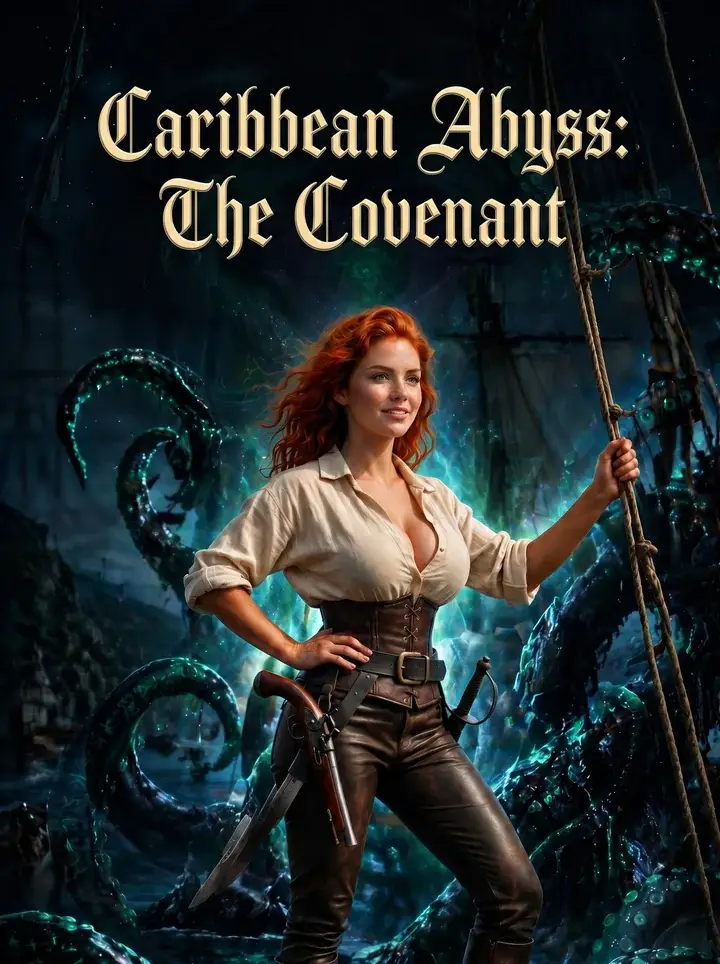
Caribbean Abyss: The Covenant is a dark fantasy pirate drama built around one irresistible question: how far can revenge carry a person before it becomes another kind of prison? At the center of the story is Anne, a pirate captain driven by the need to avenge her family. Her grief does not remain private or quiet. Instead, it pushes her toward the most dangerous force imaginable: a deadly pact with a deep-sea kraken. From that moment, her personal vendetta expands into something mythic, turning the Caribbean into a battleground of fire, magic, blood, and monstrous power.
What makes Caribbean Abyss: The Covenant compelling is the way it blends classic pirate adventure with supernatural horror. Anne is not simply sailing for treasure or freedom; she is commanding the deep itself. Her lethal crew becomes part of a storm that threatens ships, empires, and perhaps Anne’s own soul. The Royal Navy’s pursuit raises the stakes, but the more haunting threat comes from the abyss she has chosen to bargain with.
The short description calls this “a siren’s revenge,” and that phrase captures the drama’s seductive danger. Caribbean Abyss: The Covenant is not only about battle; it is about desire, sacrifice, and the terrifying cost of power when pain becomes a covenant.
Anne’s Character Study: Grief, Command, and the Price of Monstrous Power
Anne’s role in Caribbean Abyss: The Covenant is defined by contradiction. She is a pirate captain, which already places her outside the law and beyond the comfort of respectable society, but her motivation is painfully human: she wants justice for her family. That emotional foundation prevents the story from treating her as a simple villain. Her choices may be violent, and her methods may unleash devastation across the Caribbean, yet the wound driving her is recognizable. Viewers are invited to understand her rage even when they cannot fully excuse what it becomes.
Her pact with the kraken transforms her from a captain into something larger and more frightening. The phrase “she commands the deep” suggests a woman who has crossed from mortal ambition into legendary power. In Caribbean Abyss: The Covenant, Anne’s authority is not limited to her ship or her crew; it reaches into the supernatural. That expansion of power makes her fascinating because it also isolates her. A leader who relies on monstrous forces must constantly prove that she is still the one in control.
The crew around Anne matters because they reflect the world she has chosen. Described as lethal, they are not passive followers or decorative side characters. They help turn her revenge into a campaign, giving physical shape to the violence she unleashes. At the same time, their presence raises a moral question: does Anne inspire loyalty, fear, or both? Caribbean Abyss: The Covenant gains tension from that uncertainty. A pirate captain can command a ship, but commanding people through blood and magic is far more unstable.
Anne’s character study ultimately rests on the thin line between empowerment and corruption. She begins as someone wronged, but the covenant offers her a weapon that may demand more than she expected. Her tragedy, if the story leans that way, is not that she wants revenge. It is that the deep may understand her desire too well.
The Kraken Covenant: Theme Exploration of Revenge, Desire, and the Abyss
The central image of Caribbean Abyss: The Covenant is the pact with the deep-sea kraken. This is more than a fantasy device; it is the story’s moral engine. A covenant implies exchange, obligation, and consequence. Anne does not simply find power. She signs herself to it. That distinction matters because the drama is not presenting magic as a harmless upgrade. The kraken’s power is deadly, ancient, and associated with the abyss, a place that symbolizes both hidden truth and total destruction.
By making the kraken part of Anne’s revenge, Caribbean Abyss: The Covenant turns grief into a supernatural contract. The ocean becomes an emotional landscape. Its tides echo her hunger for vengeance, while its depths suggest everything she refuses to confront. If the Royal Navy represents visible authority and political order, the kraken represents something older than law: appetite, terror, and the pull of the unknown. Anne’s alliance with that force allows her to challenge empire on the surface, but it also binds her to something that cannot be reasoned with in human terms.
The pact also deepens the theme of desire. The long description names revenge, desire, and blood-soaked waves as key elements, and desire here should not be read only as romance or temptation. It is the desire to be powerful enough to never be helpless again. It is the desire to answer loss with impact. It is the desire to make the sea itself remember her pain. Caribbean Abyss: The Covenant understands that revenge stories are often fantasies of control, but it complicates that fantasy by attaching control to a monstrous source.
This is where the drama’s dark epic tone becomes important. The covenant is thrilling because it gives Anne what she needs to fight back, but it is frightening because it may also reshape what she wants. The deeper she draws from the abyss, the harder it may become to tell whether she is using the kraken or being claimed by it.
Key Turning Points: Fire, Magic, and the Royal Navy Closing In
Caribbean Abyss: The Covenant appears to be built around escalating confrontations, and its most important turning point is clearly Anne’s decision to sign the deadly pact. Before that moment, her revenge belongs to the realm of human conflict: a pirate captain seeking retaliation in a violent colonial seascape. After it, the story becomes a supernatural war. The Caribbean is no longer merely a setting of ships, ports, and naval pursuit; it becomes a stage for fire and magic, where the ocean itself can be weaponized.
That transformation gives the drama its key visual and emotional rhythm. The phrase “storm of fire and magic” suggests scenes where natural and supernatural forces collide. A naval chase can become a nightmare. A pirate attack can become a ritual of vengeance. A wave can feel like judgment. In Caribbean Abyss: The Covenant, spectacle is likely tied closely to character psychology: the more Anne’s wrath intensifies, the more the world around her seems to burn, break, and drown.
The Royal Navy’s arrival as an opposing force is another crucial pressure point. They are not just pursuers; they represent the world trying to contain Anne’s uprising. Their pursuit forces her to prove whether her monstrous pact can overcome organized military power. Yet this conflict also complicates audience loyalty. If Anne’s revenge creates widespread destruction, then the Navy’s pursuit may appear necessary, even if the story positions them as antagonistic to her freedom. Caribbean Abyss: The Covenant works best in that gray zone, where viewers can feel the thrill of Anne’s rebellion while sensing the danger of what she unleashes.
The most powerful scenes in a story like this are rarely only about who wins a battle. They are about what each victory costs. Every display of kraken-born power can be read as both triumph and warning. Each time Anne conquers the tides, the abyss may be moving closer.
Ending Explained: Can Anne Conquer the Tides Without Losing Herself?
The ending question built into Caribbean Abyss: The Covenant is brutally simple: will Anne conquer the tides, or be swallowed by the abyss? That question is not only about survival. It asks whether revenge can remain a tool once it has been fed with blood, magic, and monstrous power. Anne may defeat enemies, terrify the Royal Navy, and command a crew fierce enough to turn the Caribbean into legend, but the deeper uncertainty is whether she can still command herself.
A story centered on a covenant naturally resists a clean moral victory. If Anne wins without consequence, the pact loses its weight. If she is destroyed outright, the drama becomes a cautionary tale about vengeance consuming the avenger. The most intriguing possibility in Caribbean Abyss: The Covenant lies between those extremes: Anne may gain the revenge she seeks while discovering that the abyss has taken something more intimate than her enemies could ever reach. Her humanity, freedom, or ability to separate justice from hunger may be the true price.
This is why the drama’s fantasy elements carry social and emotional meaning. Pirate stories often romanticize freedom on the open sea, but Caribbean Abyss: The Covenant darkens that fantasy. Anne’s freedom is inseparable from violence, pursuit, and supernatural debt. The Royal Navy’s presence evokes systems of control, while Anne’s rebellion exposes how personal grief can become political chaos when amplified by extraordinary power. The drama does not need to name every historical detail to feel culturally charged; the Caribbean setting alone brings echoes of empire, maritime law, outlaw survival, and contested sovereignty.
For viewers searching for a fantasy revenge drama with a sharper edge, Caribbean Abyss: The Covenant offers more than sea battles. It is a story about what happens when a wounded captain turns the ocean into an accomplice. Its likely emotional aftertaste is not comfort, but awe: the sense that Anne’s revenge may shake the world, even if the abyss is waiting to collect its due.
想親自體驗嗎?立即觀看Caribbean Abyss: The Covenant — 全劇集已上線。
立即觀看